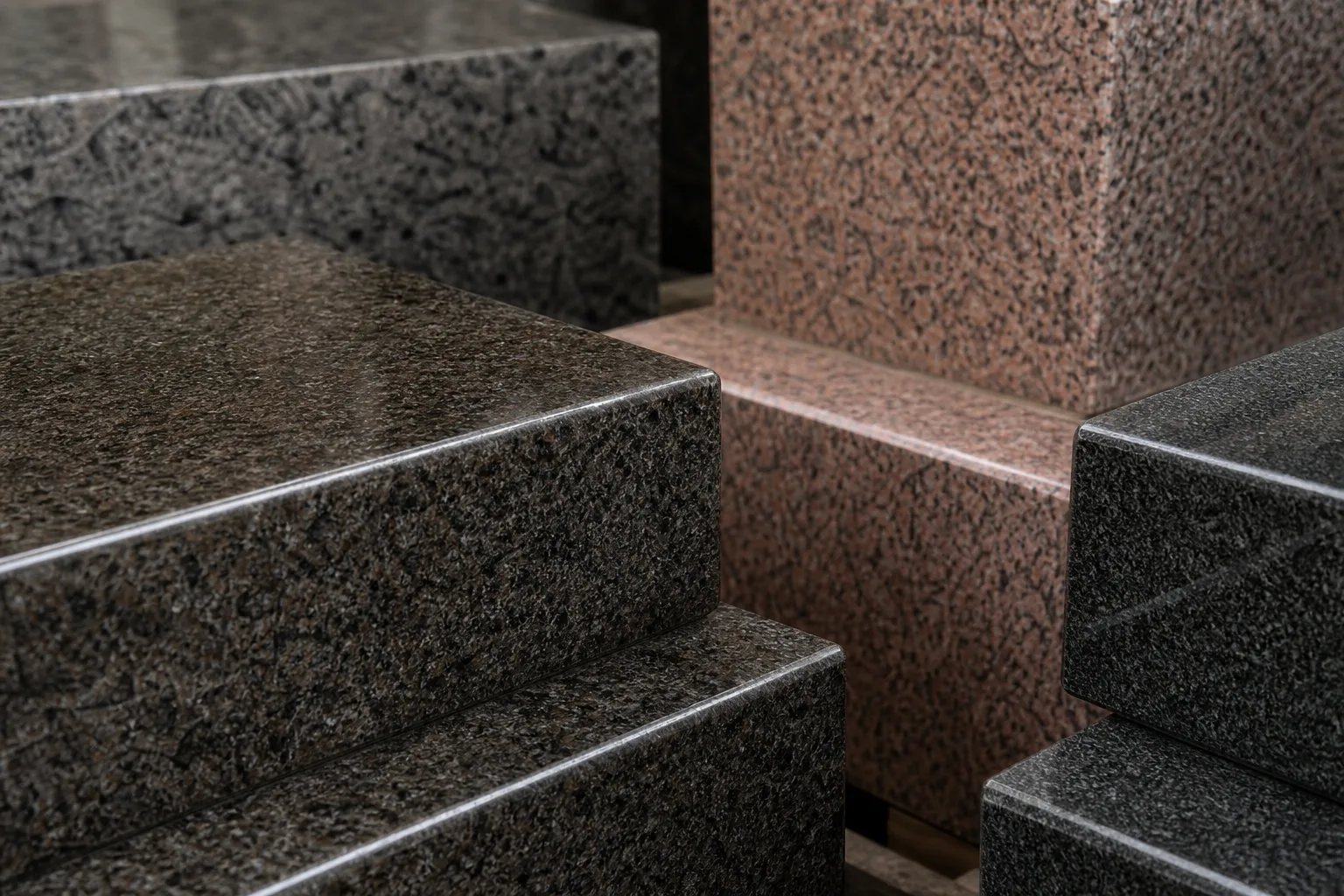
One monument order followed all the way through, from the cemetery office to the dealer to the crew that poured the foundation, with the figures and rules that came back at each step.
A monument quote usually arrives as a single figure with a drawing attached, and the drawing gets all the attention. The figure deserves more. Behind it sit six or seven separate costs, some of which the dealer sets, some of which the quarry sets a year in advance, and at least one of which the cemetery sets and the dealer merely collects and passes along. A careful reader asks for the quote broken out before signing, because the parts behave differently, and knowing which is which is the difference between negotiating and simply asking for a discount.
The die and the base are one purchase, not two
The upright portion is the die; the piece it stands on is the base. Together they are the largest line on almost every quote, and they are priced by cubic volume rather than by height, which is why a stone that looks only slightly bigger can cost noticeably more. A die two inches thicker carries stone across its whole face and depth. Dealers order from a finite set of standard sizes because those are what the quarry blocks and the polishing plants run, and asking for a size just outside the standard set is the fastest way to add cost without adding anything visible.
Quarry and color move the number more than anything else
Gray granite from a domestic quarry, sold in volume and cut in ordinary sizes, sits at the bottom of the range. Reds, blacks, blues and the heavily figured stones sit above it, sometimes well above, because the deposits are smaller, the waste rate in cutting is higher, and much of what the trade sells is imported and priced with freight and currency built in. Color is where a family can make the largest single change to a quote while keeping the same dimensions, the same design and the same cemetery approval, and it is worth pricing two or three stones side by side before the order goes in.
Lettering is labor, and it is priced by the character
Sandblast lettering starts with a rubber stencil, cut by machine now rather than by hand, then a blast cabinet and an operator. Standard block or Roman letters in a common size are close to a fixed cost per character. What raises it is anything the stencil cannot do quickly: shaped or etched panels, portraits, deep V-cut work, gilding, or a long inscription set in a face that has to be laid out by eye. A second name added later, cut in the cemetery rather than in the shop, is billed as a separate trip and priced accordingly, which is worth knowing when a companion stone is ordered years before it is finished.
Foundation, setting and freight belong to different parties
The concrete foundation is a poured footing sized to the stone and to the cemetery's specification, usually with a depth and a projection the office will state in writing. Some cemeteries pour it themselves and bill the family; others let the monument dealer's crew do it under permit. The setting fee, where one exists, is the cemetery's charge for opening the section, supervising the work and inspecting the result, and it is not the dealer's money. Delivery covers the truck, the boom or tripod, and the crew hours, and it scales with weight and with how far the equipment has to travel from the road.
What is negotiable and what only looks it
The cemetery's setting fee, its foundation charge, and any permit are fixed by the office and will be identical from every dealer in the county. The stone, the color, the size and the amount of lettering are the family's choices, and each of them changes the price honestly. The dealer's margin, freight and shop labor are real costs with limited room in them. The Federal Trade Commission oversees how funeral goods and services are priced and disclosed to consumers, and asking for an itemized written quote is an ordinary request, not an awkward one. Two itemized quotes from two dealers are readable against each other; two lump sums are not.
The useful test is simple. Take the quote, mark which lines the cemetery controls, which the quarry controls, and which the dealer controls, then take the third group back to the dealer and the first group back to the office. Most families find the savings sit in the second column, in a color they had not considered, rather than anywhere they were expecting to argue.